
Views: 0 Author: YGYINGJIE Automotive Specialist Publish Time: 2026-09-09 Origin: Site


For BMW drivers in cold climates, a heated steering wheel can be an everyday comfort feature rather than a luxury. On vehicles equipped with lane-departure, blind-spot or hands-on-detection systems, the wheel may also contain a vibration actuator, sensor mat and dedicated wiring. A custom BMW steering wheel must therefore be specified around the vehicle's original equipment—not selected from the model year alone.
This guide explains how heating, haptic vibration and capacitive sensing can be retained when a BMW steering wheel is rebuilt with carbon fiber, Nappa leather or Alcantara. Compatibility depends on the VIN, production date, original wheel, switch modules and driver-assistance package. For broader fitment planning, review our BMW F80 M3 and F82 M4 steering wheel guide.
System | What must be confirmed | Custom-build consideration |
|---|---|---|
Steering-wheel heating | Factory option, activation control, connector and wheel type | Heating element, temperature sensing and harness must match the vehicle |
Haptic vibration | Lane-departure or blind-spot equipment and original actuator | Correct mounting pocket, damping and electrical connection are required |
Hands-on detection | Driver-assistance package and sensor-equipped original rim | Compatible sensor layer must be preserved without damage during upholstery work |
Multifunction controls | Button layout, heating switch location and original modules | Transfer only the components confirmed for the ordered configuration |
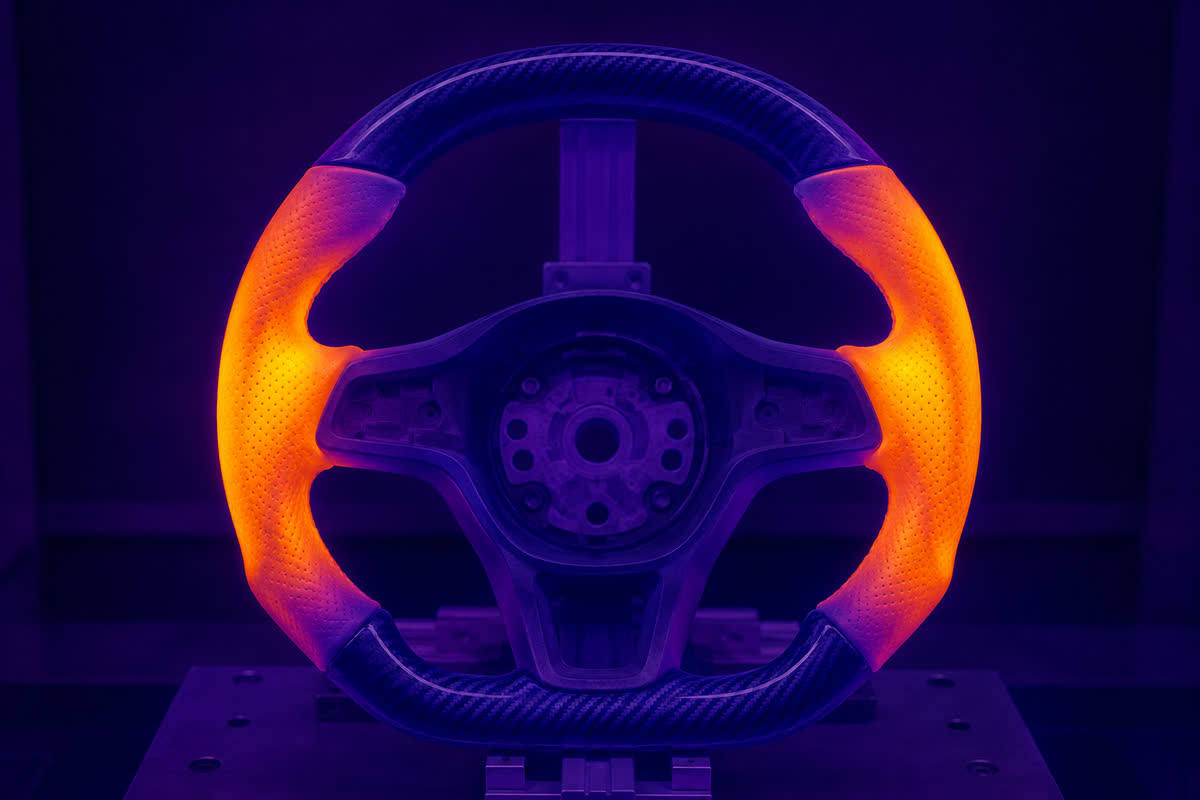
A heated rim uses a resistance element beneath the grip covering together with wiring and temperature-control components. The exact architecture varies by chassis and equipment. When a wheel is rebuilt, the technician must protect the heating circuit from cuts, sharp bends, pinching and uneven overlap.
Carbon-composite sections behave differently from upholstered grip zones. Thick composite and clear-coat layers do not transfer heat to the driver's hands in the same way as leather or microfiber. For this reason, many custom configurations concentrate useful warmth in the 9-and-3-o'clock grip areas. The ordered heated area, warm-up behavior and activation method should be confirmed in writing before production.
Leather is generally easy to maintain for daily use. Alcantara can provide a higher-friction surface but needs more regular care. Owners comparing the two can read our BMW Alcantara grip and maintenance guide.
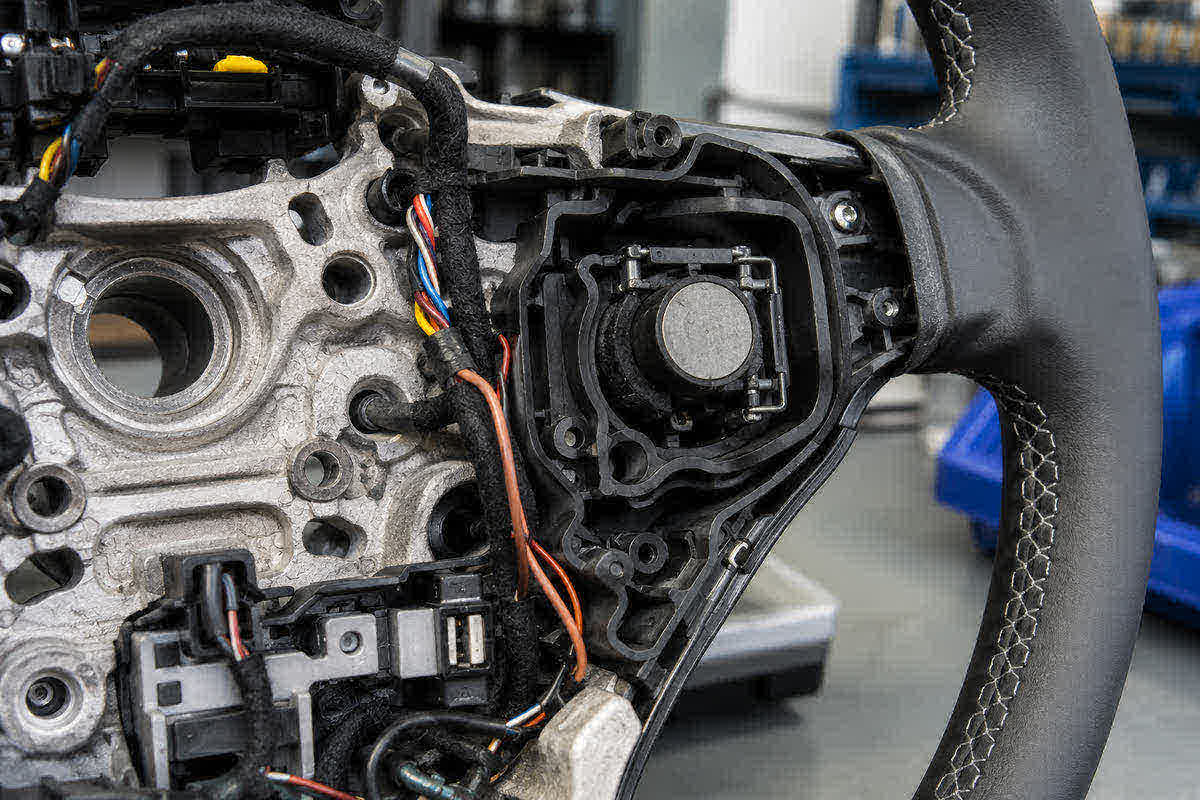
Some BMW driver-assistance configurations warn the driver through a small eccentric-mass actuator mounted inside the steering-wheel structure. When the control system energizes the motor, its offset mass creates a vibration that is transmitted through the rim.
The actuator must sit securely in a compatible pocket with the correct isolators and harness routing. A loose or incorrectly positioned motor can rattle against trim, weaken the intended feedback or damage nearby wiring. Buyers should provide clear front-and-rear photos of the original wheel and identify which alerts currently use steering-wheel vibration.
Some newer BMW driver-assistance packages use a sensor layer beneath the rim covering to detect whether the driver's hands are on the wheel. This is different from systems that infer driver input through steering torque. The applicable sensor type must be identified from the vehicle configuration and original wheel.
During custom upholstery, a compatible sensor layer must remain correctly positioned and electrically intact. Carbon layout, grip thickness, seams and adhesive placement can all affect the available installation space. A seller should not promise hands-on detection from a generic shell or from the chassis name alone.
Switch modules also vary across builds. Our BMW M1/M2 button retention guide explains why the original button layout and harness are important during a custom build.
The clockspring provides the rotating electrical connection between the steering wheel and the vehicle. Heated-wheel circuits, buttons, paddles, vibration actuators and sensors may use different pins and modules depending on chassis and equipment. Heating cannot be added safely by assuming that an unused connector is powered.
A compatible heated configuration normally requires the correct element, temperature-control component, connector terminals, activation control and vehicle-side support. If the vehicle did not originally have heating, additional hardware and coding may be required. That retrofit should be evaluated by a BMW-qualified specialist before parts are ordered.
The steering wheel houses the driver's airbag and connects to SRS wiring, so installation should be completed by a qualified technician. Battery isolation, wait time, airbag handling, clockspring centering, fastener replacement and tightening values must follow current service information for the exact VIN. Do not apply a universal procedure or torque value to every BMW chassis.
After installation, the technician should check the horn, multifunction buttons, paddles, heating, vibration and hands-on detection where equipped. The vehicle should also be scanned for stored faults. See our BMW steering wheel installation and safety-check guide for the complete workshop checklist.
Yes, in a compatible configuration, but useful heat is usually focused in upholstered grip zones. Confirm the heated area, control method and retained components before production.
Possibly, but it may require vehicle-side wiring, a compatible clockspring or steering-column module, an activation control and coding. A custom wheel alone cannot guarantee that the retrofit will operate.
A correctly matched build should retain the specified systems, but no universal fault-free result can be promised without verifying the original equipment, transferred modules, wiring and post-install diagnostics.
They can coexist in some made-to-order configurations because the systems occupy different areas, but power, wiring, housing space and the exact wheel design must be reviewed together. See the BMW LED shift-light steering wheel guide.
VIN, chassis code, model year and production date
Clear front-and-rear photos of the original steering wheel
Location of the factory heating control
Driver-assistance options and current vibration behavior
Functions that must be retained
Preferred carbon finish, grip material, stitching and rim shape
Browse the YINGGENE BMW steering wheel collection, view a BMW custom wheel with heating and vibration options, or contact YINGGENE for a configuration review.
Trademark, affiliation and compatibility notice: YINGGENE is an independent aftermarket brand and is not affiliated with or endorsed by BMW or any vehicle manufacturer. Products discussed here are modified aftermarket products, not new original BMW products. Compatibility and retained functions must be confirmed against the customer's exact vehicle configuration before production. All trademarks belong to their respective owners.


